
Once Again, Coherence
Further Thoughts on the Center of Anglican Identity

I’m excited to start my class on the 39 Articles soon, and instead of preparing all of my other lecture notes, I am still obsessing about this question about a coherent Anglican identity. As a reminder from my previous post, the difficulty I’m struggling with is not only to acknowledge the reformed heritage of Anglicanism, but to accept it, while also recognizing that Anglicanism took a different line of development from the capital-R Reformed tradition, and that does not represent a corruption of the reformation heritage but a legitimate development of it. As much as I cut my scholarly teeth in the world of the early church Fathers, I’m not convinced of the reading of Anglicanism that treats the Anglican tradition as just English Orthodoxy redux. The English divines had great respect for the theology and witness of the early church, but a coherent Anglican identity has to be more than just Eastern Orthodoxy cosplay.1 So I continue to trudge along on my search, and in this post, I want to note a few points that are bubbling to the surface that I need to work through.
As a commenter on my first post noted, I came across as assuming an inherent unity within Anglicanism from the start. Wasn’t Anglicanism, he noted, just a series of political compromises? Here is part of my response:
I agree that the Articles have various aspects that do not necessarily start from a single unified place because, as you note, a lot of it is compromise. I don’t think all compromise is bad, and I would be suspicious of a Church that never attempted good compromise (Oliver O’Donovan has influenced me in this regard). And if the motivation of ecclesial leaders is just to shut people up and keep them happy enough not to cause problems, that is irrelevant as to whether there is some kind of conceptual coherence to the system as a whole. I’m focusing on the latter.
So I’m not arguing that the Articles are a single theology, but that the core of what we think of as “Anglicanism” is aligned and weighted around Hooker’s concept of Law, which came after the fact (in the same way that the Reformed tradition developed covenant to do something similar). Any conceptual framework will not exist without variation at all (even with the prominence of Aquinas’ thought in Roman Catholicism, a lot of variability still exists!), so I’m not trying to flatten all of the differences out, but instead understand how it can all fit together.
I want to further two points of my response.
First, the more I reflected on this exchange, the more it became apparent to me that part of the difficulty in discerning a coherent Anglican identity that doesn’t reject its Reformation heritage is the overwhelming impulse to treat the later capital-R Reformed tradition as the natural development of the English Reformation tradition, and so anything less than that is inherently deficient. Perhaps part of the difficulty is linguistic: using the same term to refer to two ultimately different things is just confusing. Maybe another part of the problem is that we’ve lived with a century and a half of Anglicans themselves denying their reformation heritage. Whatever the cause, as I approach this question, my methodological starting point is that what became Anglicanism and what became the Reformed tradition are two equally legitimate developments from common Reformation commitments. I think those commitments are expressed well in the 39 Articles.
Second, in regard to compromise, I think we need to accept the fact that the process of articulating theology for the church will always be a matter of compromise. Some who confuse their own cleverness for truth would rather everyone adopt their own entirely coherent and consistent system so that all theological problems would disappear. Unfortunately, for those of us in the real world with real relationships and, apparently, sub-par intelligence, we must be content to try to figure these things out within and for our community, which, per se, requires compromise. But this isn’t new. Gregory of Nazianzus was famously dissatisfied with the creed of the Council of Constantinople (381)—the one we recite every morning—because it was soft on declaring the Holy Spirit to be fully God. So in response, he went home and wrote poetry and edited his theological works and letters, the effect of which was that later generations interpreted the council through his eyes. If that was true for the Council of Constantinople (381), why should we expect anything less from every other Christian gathering?
Building on these observations, I think it is also important to remember that systemization and coherence are always secondary. One of the fascinating things I learned reading Brian Tierney’s Origins of Papal Infallibility, 1150-1350 is that one of the expectations of medieval theologians (and to some extent modern Catholic theologians) is not to come up with doctrine but to synthesize and defend the doctrine the Church has already declared. I’m sure there is nuance to this, but I think that gets the point across, and I want to think of my attempt at finding coherence as functioning in a similar way. The 39 Articles are a conglomeration of doctrinal positions addressing different issues or controversies. They don’t begin with some systematic coherence; that coherence has to be developed later. My intuition is that what we think of as Anglicanism and the Reformed tradition (at least as it existed within the Church of England for a time) were both overlapping yet ultimately diverging ways of systematizing these doctrines (as well as the other Formularies).
This means that my attempt at finding coherence between where Anglicanism started (a broadly reformed tradition) and where it ended (this distinct thing we call “Anglicanism”) must identify what it is that ultimately led to this “split”. I put split in scare quotes because many within Anglicanism proudly wear the badge of capital-R Reformed. I think that one can claim both labels because of that shared lowercase-r reformed tradition, though I do think it causes problems that periodically erupt (e.g., the Gorham Controversy). And the “cause” might not even be one thing! Right now, I’m not attempting to solve all the problems, so I want to be clear that by focusing on one thing, I am not proposing it as a single explanation, but as one of the factors that ultimately led to the creation of Anglicanism as a distinct tradition in its own right.
I am not focusing on the scholarly discussions about avant-garde conformism, Reformed Conformist, anti-Calvinist, or anti-Arminian that are often brought up in discussions about the development of the Anglican tradition. These are historiographical categories, and they play an important role, but, unfortunately, they all play into this idea of some kind of corruption or illegitimate shift from the “mainstream” Elizabethan Anglicanism. Instead, I am presupposing a greater amount of coherence with the “mainstream” of Elizabethan divines than these kinds of narratives like to admit.2 Instead, I am trying to identify a particularly theological reason for the distinctiveness of the Anglican tradition. That is, what is the particular idea that, as divines strove for greater coherence of their theological systems, grew into differences between the traditions?
That being said, the issue I want to focus on is the Reformation criticism of the Roman Catholic account of human nature, as that seems to me to be one of the fundamental doctrinal differences that get worked out into their different accounts of justification, etc. Specifically, I’m thinking about the teaching on natura pura and the donum superadditum. I’m going to paint with broad brushstrokes here, so here is my hand waving, acknowledging that “it’s complicated”.
As it goes, the account of human nature that developed in the Western medieval theological tradition, while not being monolithic, does seem to have some basic points. The first is that God created humans with a “pure nature” (natura pura), meaning that human nature qua a created nature, has an end/telos fitting to its reality as a created thing. The important factor is the creature’s finiteness vs God’s infiniteness. A finite creature cannot have an end/telos that is infinite because it is not proportionate to its nature. It would be like saying the end/telos of human nature is to fly, even though we have nothing in our nature conducive to flying. In order to remedy this problem, that is, in order to bring this created being into relationship with God, God gives a gift/grace to the creature. This is often called the superadded gift (donum superadditum) because it was a) a gift/grace given over and above humanity’s created nature, b) in order to equip humans to have God, the infinite, as their supernatural end. This gift was a helpful aid in keeping the natural parts of the soul in order, since sin is a result of the disorder of the soul (e.g., allowing our appetites to control our actions instead of submitting them to reason, which is directed toward God). By the time of the Reformation, this was used by some, though not all, to justify the idea that one could do what “was within oneself” prior to any gracious action of God. This action would then merit (congruously, not condignly) grace from God in return as a reward. This also connects with ideas about the nature of faith, grace, habit, justification, etc, but that is not my concern here.
Reformers are consistent in their critique of this anthropology. None, Lutheran, Reformed, or Anglican, held to a doctrine of pure nature. Instead of beginning with an understanding of nature vs grace, the Reformation traditions began with an understanding of humanity created in the image of God. As such, they all generally agree on the idea that humans are created to be in a relationship with God from the beginning. It just doesn’t make sense to analyze, in their mind, human nature, even in the abstract, apart from being created to be in a relationship with God as the image of God. This has significant consequences for their understanding of the fall (e.g., total depravity), and articulations of faith, grace, justification, etc, which I will not get into here. My point so far is this: all Reformation traditions agree. They might have different ways of explaining it (e.g., Lutherans tended to define it Christologically, Reformed also make additional distinctions between the intrinsic and extrinsic image of God, etc).3
One of the interesting things for me about Richard Hooker is how he outlines his understanding of Law. Now, as I recently read in an essay by Bradford Littlejohn, I think we must be cautious about drawing too sharp a distinction between Hooker and other Reformed thinkers as if Hooker’s account was something radically unique within the world of Protestant theology or some backdoor to some creeping Thomism. Littlejohn shows that there is actually a significant amount of overlap with Hooker’s account of law and that of Franciscus Junius, who published a work around the same time as Hooker’s first four books of the Lawes.4 They both draw on Thomas, and they both make adjustments to this shared inheritance in light of Protestant commitments. Now, I have not read Junius’s work (yet), but one of the features of Hooker that stood out to me when I read him is how he seems to speak of law as a kind of internal principle inherent within creation, directing creatures back to God. These inherent principles are part of the “second eternal law” (possibly an attempt at guarding the Creator/creature distinction. This second eternal law seems to mirror the first, which is the law that orders God’s being, which is just God’s self. So it is not God, but it is not contrary to God because it reflects something of God’s nature, but in a way that we as creatures can participate.
So my question is: if my understanding of Hooker is correct, is there anything analogous to this internal directionality toward God that is a part of creation qua creation in Reformed theology? I know very little about the technicalities of covenant theology, especially the covenant of works, but from the little skimming I’ve done, it seems to me that the covenant of works is the concept used by later Reformed orthodoxy to express how it is that humans are directed towards not. That is, while all the Protestant traditions agree that we are created to be in relationship with God as our proper end, the Reformed express this via the concept of the covenant of works, whereas Hooker’s account of Law allows it to be an internal principle within the creature qua creature.
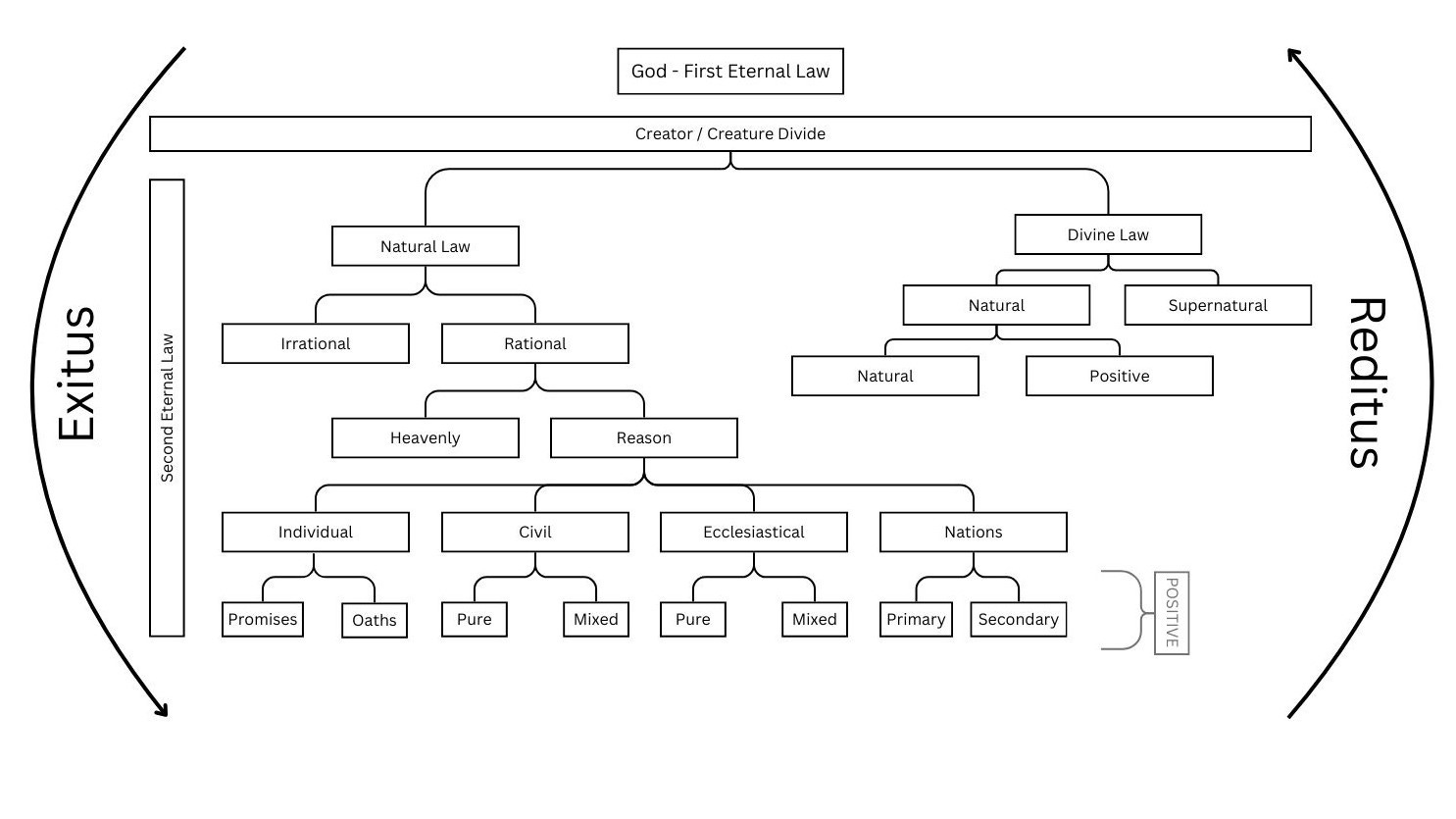
I really don’t know if this is correct, so I do hope for some helpful comments! But for now, I could see how this difference would result in ultimately different emphases of a shared Reformation tradition (e.g., they still differ from the Roman Catholic account for the same reasons, Hooker and Junius have very similar accounts of law, etc). Could this explain why Hooker and those who followed him (Andrewes, Laud, etc) emphasized prayer and the sacraments over sermons? That is, prayer and the sacraments seem (to me at least) to feel more connected to our created existence—and the “beauty of holiness” naturally follows from this as well—whereas sermons are more appropriate for teaching and enforcing covenant obligations.5 I do think minimally this makes sense of their differing emphases regarding baptism (instrumental means of grace vs a seal of the covenant). What I’ll need to figure out to test my thesis is whether, in fact, later Reformed theology 1) denied any intrinsic orientation toward God as part of humanity’s nature, and 2) if that is indeed an accurate reading of Hooker.
I’m being a little cheeky here to make a point. I know there is a more substantial theology that undergirds such approaches.
At least in my experience. I’m not as well-read in these debates as I would like to be, so I speak from a general impression that I have gathered as I have become more familiar with the contours of these scholarly debates.
Muller explains these helpfully in his Dictionary of Latin and Greek Theological Terms.
W. Bradford Littlejohn, “Cutting Through the Fog in the Channel: Hooker, Junius, and a Reformed Theology of Law,” in Richard Hooker and Reformed Orthodoxy.
I am not making a claim that Reformed theology is voluntarist; I think a close reading of the Reformed scholastics has put that to rest.
Reformed thinkers like Turretin, Junius, Voetius, and Vermigli adopt (selectively) the Thomistic understanding of natural law.
This is not as metaphysically thick as Hooker, but the structure is similar.
Calvin has a teleological orientation embedded in creation, but doesn't seem to call it a natural law.
The Reformed typically resist language that implies metaphysical participation in God’s being, for fear of blurring Creator/creature distinctions.
Hooker is more comfortable with participation metaphors; the Reformed prefer imaging or obedience-to-structure metaphors.
So yes — the Reformed tradition acknowledges a built-in orientation toward God, but they frame it less as participatory ontology and more as created order + covenantal obligation.