
Here I Am
A Good Friday sermon

Lessons
Genesis 22:1-18
Psalm 40:1-10
Hebrews 10:1-18
John 18:1-19:37
Sermon
I want to begin tonight with our lesson from Genesis 22. Much could be said about this text, and I could try to answer the question of why God would test Abraham, or why God would test Abraham by asking him to offer his son as a sacrifice, or, perhaps even more shocking, that Abraham was willing to do it! All of these are worthwhile questions, but I want to take a different route this evening by exploring a seemingly insignificant detail in the opening of our passage. Genesis 22:1-2 says this:
After these things God tested Abraham. He said to him, “Abraham!” And he said, “Here I am.” He said, “Take your son, your only son Isaac, whom you love, and go to the land of Moriah and offer him there as a burnt offering on one of the mountains that I shall show you.”
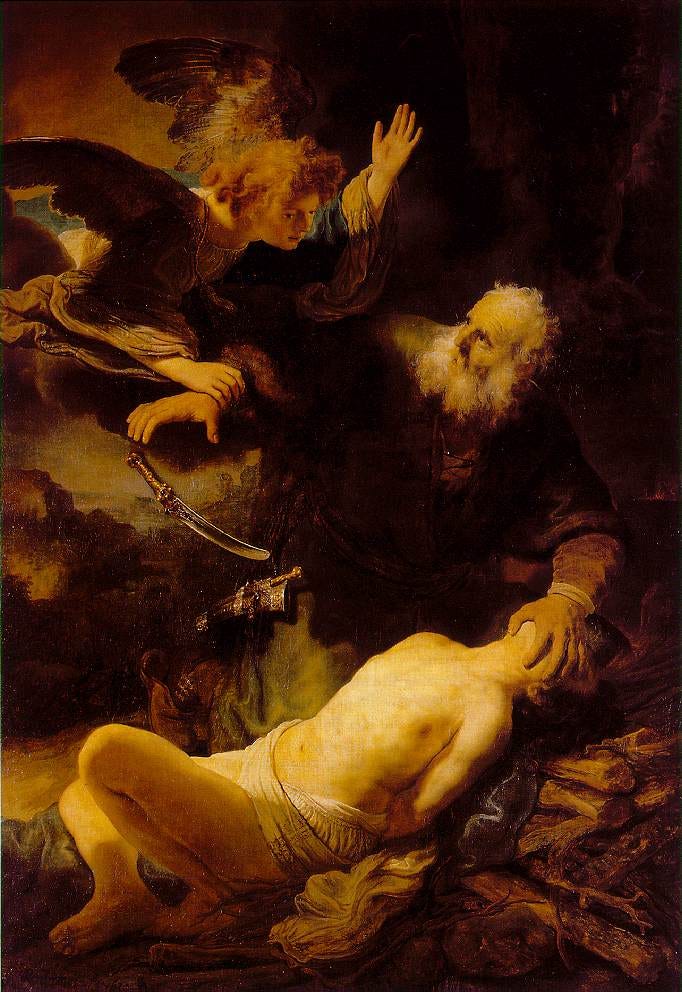
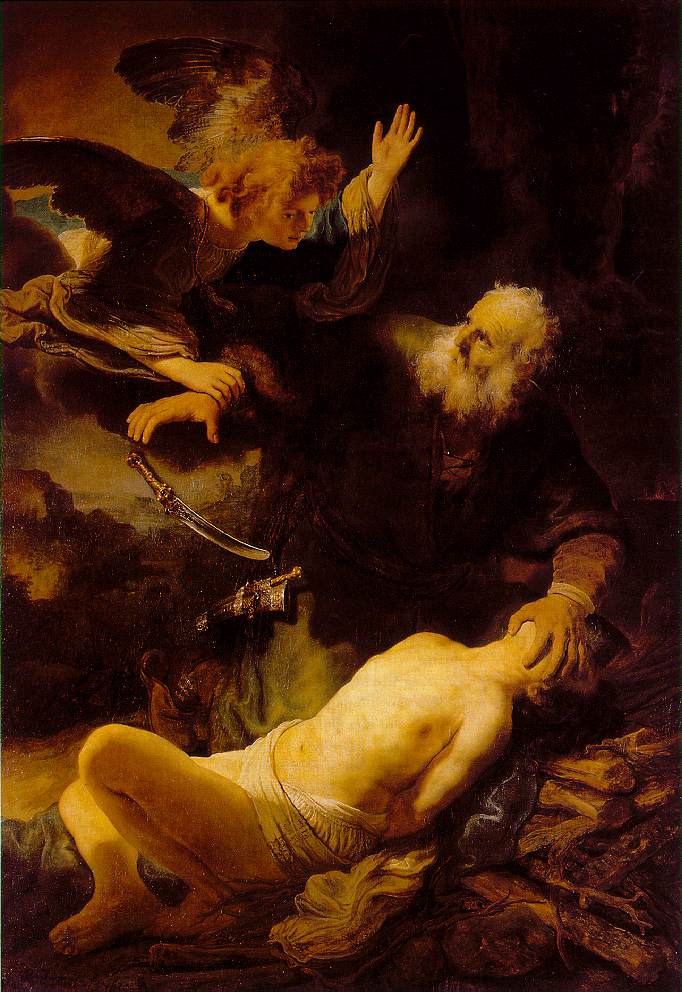
I want to draw your attention to the fact that God commands Abraham to offer Isaac as a burnt offering. The first time we hear of a burnt offering in the biblical narrative is when Noah exits the ark after the floodwaters subside. Genesis 8:20 says that he offered as a burnt offering some of the clean animals and birds he had preserved on the Ark, and it is in response to this offering that God promises never to flood the world again. Our story here is the second time it appears in the Bible, and it doesn’t appear just once. The term burnt offering is repeated six times in this short story. When you read the Bible, and you see the same word or phrase being repeated multiple times in a single narrative, it is a clue to pay attention to what is being said. So while we might think this detail is insignificant, the repetition of the phrase “burnt offering” actually tells us this is something that is important to the story as a whole.
But what exactly is a burnt offering? Now, when it comes to sacrifices in the Old Testament, I think we often only think of sacrifices for sin, notably, the sacrifice offered by the High Priest on the Day of Atonement. But the sacrificial system in the Old Testament, laid out in most detail in the book of Leviticus, includes more than just sacrifices for sin. In fact, there were five principal sacrifices described in Leviticus:
Burnt Offering
Grain Offering
Peace Offering
Sin Offering
Guilt Offering
Each sacrifice had its own unique liturgy and purpose, and while I would love to go into all the nuances of each sacrifice, I’ll just give a summary to help us understand the significance of God asking Abraham to offer Isaac as a burnt offering. Let’s work in reverse order.
The guilt offering was for unintentional sins that, when one realizes that they had sinned, they offer a guilt offering, which was comprised of a sacrificed animal and an additional one-fifth penalty added on to the sacrifice as a kind of restitution. This 1/5th penalty was the unique feature of the guilt offering.
The sin offering was also for unintentional sins or ritual impurities. The emphasis is on what the priest does with the blood of the animal to make atonement, both the cleansing from the stain of sin and ransoming from death.
The peace offering could be offered for various reasons, such as a thanksgiving for an unexpected deliverance, a vow offering upon fulfilling a promise made to God, and a freewill offering as an act of spontaneous worship. The unique feature of the peace offering is that it is shared between all parties: a portion is given to God, to the priests, and to the offerors.
The grain offering was a non-animal offering that was a kind of tribute offered to God in gratitude for the provisions God had provided.
Finally, the burnt offering. Not only do individual Israelites bring burnt offerings, but God also commands a burnt offering to be offered by priests in the Tabernacle every morning and evening. In many ways, the burnt offering is the paradigmatic offering in the entire sacrificial system, and we’ll see why in a minute. What makes the burnt offering unique is that it was the only sacrifice that, except for the skin, was completely burnt up on the altar. Unlike the grain, peace, sin, and guilt offerings in which the priests are given a portion, the burnt offering is completely given to God by being turned into a smoke that ascends into heaven.
So God tells Abraham that he wants him to offer his son Isaac as this particular kind of offering: totally and completely consumed by fire and given to God with nothing held back. In many ways, this makes sense of why God’s command to Abraham is a test. Isaac is the promised son through whom all of God’s promises given to Abraham in Genesis 12 would be fulfilled. Isaac is everything to Abraham. Indeed, as our text says, he is Abraham’s only son, the one whom he loves.
But before this just becomes a sermon where I tell you to think of what you love and give that up to God, there is a complication, and that complication is found in our Psalm reading for this evening. Psalm 40:6 says:
Sacrifice and offering you do not desire,
but you have given me an open ear.
Burnt offering and sin offering
you have not required.
This language of God not requiring or desiring sacrifice is actually something that shows up often in the Old Testament, specifically in the prophetic tradition. Isaiah, Jeremiah, Amos, Hosea, Micah, and Malachi all have a critique of the sacrificial system that says something to the effect of what our Psalmist says: God doesn’t actually want sacrifices. But if that is true, then why does he command Abraham to give it? Why does he not only give detailed instructions on how to do it in Leviticus, but command that a burnt offering in particular be offered every single morning and evening? Do all outward expressions of worship suffer the same fate? Does God despise our regular offering of worship? Tonight’s?
Many have read the prophetic critique along such lines, but I think something else is going on here, and a clue can be found in verses 7-8 of our Psalm, which says:
Then I said, “Here I am;
in the scroll of the book it is written of me.
I delight to do your will, O my God;
your law is within my heart.”
Did you catch that? What is compared to the burnt and sin offering in verse 6 is the very answer Abraham gave to God when God called out to him, and he said, “Here I am.” The Psalmist explains what this means as delighting to do God’s will, or having God’s law within your heart. In fact, Abraham repeats the “Here I am” three times in the narrative. When God calls him the first time, second when Isaac addresses him, and finally when God calls out to Abraham the last time to stop him from sacrificing his only son, whom he loves. Unlike Adam, who, when God called out to him, hid because he was afraid, Abraham responds to God’s calling by saying, “Here I am.” Indeed, his actions throughout the narrative are ones of absolute obedience to and trust in God, a kind of total and complete giving over to God of himself. Which is exactly what we saw was the feature of the burnt offering.
But there is one element about the burnt sacrifice, indeed all animal sacrifices, that I didn’t mention, and I think it is the bridge that brings together these two ideas I’ve been discussing: that is, the total consecration the burnt offering represents on the one hand and the perfect obedience represented by the “here I am” on the other. And that is this: when an offeror brings an animal as their sacrifice, they first lay their hands upon the head of the animal in a ritual act of identification before they, the offeror, kill the animal. It is an act that says, in a way, “here I am,” I am this animal, and the sacrifice and total consecration to God expressed in the burnt offering is not of the animal, but of me.
So the burnt offering is a sacrifice that combines the ritual identification of the offeror by the laying on of hands with the sacrificial animal that is completely given over to God. Without this ritual identification, the animal is just a bloody carcass being roasted over a fire. But God does not need a BBQ as if he were hungry and our jobs were merely to feed him to keep him on our good side, a common approach to the gods of the ancient world, but not of the God of Israel. This is why God says he doesn’t desire burnt offerings or other sacrifices in Psalm 40 and throughout the prophets, because a sacrifice without the “here I am” completely undermines the purpose of the sacrifice. They are two sides of the same coin. The burnt offering is a visible sign of this invisible reality, and the action of the burnt offering attempts to accomplish through the animal what is owed to God: ourselves. God doesn’t want the offering; God wants what the offering points to, what the offering in some small way tries to give to God, which is the very offeror themselves. That is what we are created for—to be in relationship with God—and that is what sin disrupts, undoes, and destroys. Sin is why Adam says that he ran and hid because he was afraid when God went looking for him in the garden.
And this is why Abraham’s actions are so significant. He doesn’t just offer a burnt offering as if God wants the flesh of bulls or goats or of Isaac, which we know he does not. What Abraham does is to act in unwavering obedience to God’s command, and it is by this act of trust, or faith, in God that Abraham passes the test. And so God provides a substitute, just as Abraham said he would, by providing a goat caught in the thicket, by which Abraham can express and fulfill his total and complete dedication to God.
But as our Hebrews passage makes clear, this type of animal sacrifice, which needs to be repeated, was ultimately ineffective. Here is what our Hebrews says:
10:1 Since the law has only a shadow of the good things to come and not the true form of these realities, it can never, by the same sacrifices that are continually offered year after year, make perfect those who approach. 2 Otherwise, would they not have ceased being offered, since the worshipers, cleansed once for all, would no longer have any consciousness of sin? 3 But in these sacrifices there is a reminder of sin year after year. 4 For it is impossible for the blood of bulls and goats to take away sins.
While the sacrifices like the burnt offerings accomplished something, they could not ultimately accomplish what is necessary, which is to “make perfect those who approach.” To be made perfect in the book of Hebrews isn’t merely some kind of moral perfection, but speaks to the total and complete access to the presence of God. The sacrifices of the Old Covenant could not ultimately provide that access because they could not fully take away sins and had to be repeated again and again. But what Christ accomplishes in the events that we specifically recall tonight is different. Hebrews continues:
5 Consequently, when Christ came into the world, he said,
“Sacrifices and offerings you have not desired,
but a body you have prepared for me;
6 in burnt offerings and sin offerings
you have taken no pleasure.
7 Then I said, ‘See, I have come to do your will, O God’
(in the scroll of the book it is written of me).”8 When he said above, “You have neither desired nor taken pleasure in sacrifices and offerings and burnt offerings and sin offerings” (these are offered according to the law), 9 then he added, “See, I have come to do your will.” He abolishes the first in order to establish the second. 10 And it is by God’s will that we have been sanctified through the offering of the body of Jesus Christ once for all.
Here we see the “Here I am” of Abraham and the Psalmist connected to the sacrifice of Christ. When Christ came into the world, from the first to the last, he lived a life saying, “Here I am, I have come to do your will” to all that God called him to. When, according to our Gospel reading, Judas betrayed Jesus, and he was arrested, Jesus was saying, “Here I am” to God. When he was abandoned by his disciples and betrayed by Peter, Jesus was saying, “Here I am.” When Jesus was questioned by the High Priest and Pilate, he said, “Here I am”. When Barabbas was released instead of him, when he was flogged and mocked, when he was rejected by his own people, and finally when he was crucified with arms outstretched upon the cross and proclaimed there once for all that “It is finished,” he said, “Here I am.”
From start to finish, Jesus lived a life of perfect obedience to the Father, and so he became the pure, spotless lamb who, as John the Baptist proclaimed near the beginning of the Gospel of John, takes away the sin of the world. In Jesus, the external sign of the sacrificial animal, which represented the life of the offeror and the perfect obedience of the “Here I am,” became one. In Jesus’s life and sacrificial death, he accomplishes what we are meant to do but what neither we nor the animal substitutes could ultimately accomplish. In Jesus, the sin that binds us and separates us from the Father is finally and fully taken away so that we can be made perfect, standing in the very presence of God, restored to the relationship we were created to have from the beginning. Whereas, in the beginning, when Adam sinned, and God called to him, he ran and hid because he was afraid, Jesus instead said: “Here I am”.
So now, not only on this day when we recall the crucifixion of Jesus, but every time we proclaim his death until he comes, both by the word and the table, the call of God goes out. But this is not merely some generic call to whoever may hear, but just as in our Genesis passage where God called Abraham by name, God is calling out to you by name. Yes, to you. God calls out to each of us by name; how will we respond? Will we, like Abraham, our father in the faith, respond and say the words of faith: “Here I am”? Not by laying our hands upon our children or a sacrificial animal or anything else, but by laying our hands upon Christ alone and saying, “Here I am”!
Will you lay your hands upon the pure, spotless lamb, the lamb that God has provided? Will you lay your hands upon the once-for-all sacrifice that finally and fully brings us into the very presence of God? And I’m not only speaking to those who have yet to lay hold of Christ, but I’m talking to all of us. Whereas the sacrifices of the Old Covenant had to be repeated, the sacrifice of the New Covenant is a single sacrifice that we return to again and again and again. When we stray from God and follow the desires of the flesh, the world, and the devil, we don’t offer a new sacrifice but lay hold again of the one sacrifice of Christ and say every single day, “Here I am!”
So I ask all who are here tonight: where are you? The gospel has been read, the story of Jesus’s sacrifice has been proclaimed, and God is calling you by name. Will you, like Adam, hide in fear, or will you lay hold of Christ by faith and respond to God by saying, “Here I am”?
"But God does not need a BBQ as if he were hungry and our jobs were merely to feed him to keep him on our good side"
~ Dr. Clevenger, 2026
More importantly, this was absolutely it:
"The burnt offering is a visible sign of this invisible reality, and the action of the burnt offering attempts to accomplish through the animal what is owed to God: ourselves. God doesn’t want the offering; God wants what the offering points to, what the offering in some small way tries to give to God, which is the very offeror themselves. That is what we are created for—to be in relationship with God—and that is what sin disrupts, undoes, and destroys."
Felt this one ring.
This might be my favorite breakdowns of the parallels between the intentions of the sacrificial system and God's heart.