
Finding Coherence in Anglicanism
How I try to square the circle.

In thinking about how to position Anglicanism amongst the magisterial Reformation traditions and post-Tridentine Roman Catholicism, one is often grasping at straws. Whereas post-Reformation Anglican divines seem to be quite certain about who they are and what they are about, 20th-century Anglicans as a whole lack a core theological identity. Why is this?
If I had to hazard a guess, I think part of this is grounded in Anglican history. What started as a national church firmly entangled within the identity of a country and culture—and so with a clear sense of identity—lost that core foundation in the early 19th century. I don’t think it would be too much to say that the Tractarians were not so much the cause of this rupture, but representative of an attempt to find Anglicanism’s identity rooted in a particularly English history and cultural expression. Hence, the Anglo-Catholic movement tends to downplay the value of the English Reformation, seeing it as an unfortunate bump in the road of an otherwise continuous parochial English tradition. While Evangelical/Reformed Anglicans treat the Reformation as a sufficient answer to Medieval Catholicism (though sometimes perhaps a little envious of the theological niceties of the broader Reformed tradition), and the Latitudinarian/Liberal Anglican tradition continues to wed—as did the English Reformers—their respective Anglican embodiments to the cultural proclivities within which they are embedded.
These are three general broad categories; there are many subspecies within each genus with their own idiosyncrasies. Not being reared in an Anglican tradition, I have felt pressure to stake out where I fit within the Anglican landscape, only to be perpetually frustrated by my inability to articulate a coherent synthesis. Since my area of scholarly expertise is the early Church, you’d expect the “Catholic” element to be strong, yet the historian in me has never found Anglo-Catholic historiography of the 16th-century Anglican tradition to be satisfying. I can’t read early Anglican thinkers as anything but reformed (broadly construed; not with the specificity of late 16th- and early 17th-century Reformed scholasticism), and I can’t deny them and the role they played in developing the Anglican formularies. Yet, the evangelical/Reformed tendency to halt all Anglican theology to the 16th century has always felt thin, and, at its heart, is suffering from presbyterian-envy (stop trying to make the 39 Articles into the Westminster Confession). I’ve never found the liberal tradition satisfying. I hate squishy thinking, and I just care too much about what the Bible says to reinterpret it under the magisterium of the scholarly guild of whatever is popular at the moment. These are all unfair summaries, but you get the point. For good reasons or bad, I just can’t sign up for #team[fill in the blank].
This presents a problem for someone who has signed up to teach a class on the 39 Articles! I’d rather not say, ¯\_ (ツ)_/¯, and I can’t just “pick” a camp and go with it (if you find this kind of waffling intolerable, you know how to pray for my wife). I want to emphasize and value the historical reformation tradition that created and received the 39 Articles, but I also want to find an intellectually satisfying way of holding that together with what is clearly a later theological tradition which began with the Caroline Divines, continued with the Tractarians, and brought about much that is beautiful and good within the current Anglican tradition (e.g., I value weekly communion and I would do incense if I could).
I’m excited that I may have found something that allows me to synthesize the Evangelical and Catholic traditions in a satisfying way. I say “found” not in the sense that I’ve made some grand discovery that no one else has ever thought of (the worst part of writing a dissertation was posturing myself in that very way; I hated it). Someone, somewhere, has probably made the point and made it better than I will. That’s okay. What is important for me at this point is that I have clarity. I write this here to open it up to critique and engagement. I have many good ideas until I tell someone, so getting the input of others is something I need.
To begin with, I have to give a little context. For my class on the 39 Articles, I want to spend some time describing in very general terms the medieval Roman Catholic system that Articles 9-18 (and others) are addressing. I think contemporary Americans who grew up vaguely evangelical and have become Anglican find some of the off-putting. How can concupiscence be a sin (Article 9)? Is everything we do before faith really sin (Article 13)? Positioning the Articles within their historical context will not only help explain what the Articles say but also why they thought they needed to say it. As much as I would love to spend an entire class explaining the nuances of Roman Catholic theology, 1) I don’t have the time, 2) it’s a lot to take in for people unfamiliar with it, and 3) there is still much I don’t grasp. So I have to contend myself with a general summary, and I think that should be sufficient for the class.
As I have been thinking about what to say and how to say—and constantly doubting my own comprehension of the subject matter and trying to do my due diligence in studying the subject—I found myself focusing on the doctrine of pure nature (natura pura) and the superadded gift (donum superadditum). From a philosophical perspective, I get what the concept does and find aspects that I think are actually good points to consider. So to better understand the Reformation debates, I began looking (confession: with some help from some AI tools) into the Reformed and Lutheran Scholastic objections to pure nature and the superadded gift and started noticing the ways that the developing Reformed and Lutheran systems found new ways to accomplish what, e.g., pure nature, does within the conceptual system.
Sidebar: I think this is generally true of the differences between various Christian theological systems. Ideas have a funny way of working themselves out, and people like theologians with little ambition for physical labor who spend their time obsessing about details and consistency will eventually build a robust and sophisticated conceptual framework. This isn’t bad; I think it’s just the way things are. So when we compare theological systems, one thing we must be careful of is not jumping too quickly to accusing one system of not addressing X just because they don’t use the same terminology as us or put it in the same place as we do within our system. For example, I noticed that while the Reformation traditions deny that grace is a “thing” that can be given, does work within us, and results in some kind of reward from God, in the way that the Roman Catholic system does, they do treat faith as a gift that is given. This faith, if it be of a certain quality (e.g., lively), results in good works, which God judges as verification of the presence of lively faith within us (e.g., a kind of reward, broadly speaking). If we were only to compare how these two systems use the word “grace”, we’d assume they are radically different and miss where there is a formal similarity. Note: this is somewhat superficial; there are other important differences. Similarity doesn’t mean identity!
Returning to my story, one of the elements within Reformed orthodoxy that began to stand out as fulfilling the function of pure nature is the concept of covenant. As I understand it now (with many caveats), it goes something like this:
The Roman Catholic system posits the concept of pure nature to point to the integrity of human beings as creatures. As such, they have an end that is proportionate to their nature. They are not, by nature, God, so they cannot have an end that is proportionate (e.g., creatures are finite, God is infinite; therefore, a finite creature cannot have as its proper created end something that is infinite). In order to bring human creatures into a relationship with God, God needs to give something they don’t have, e.g., grace, in order to make the creature capable of being in a relationship with God. What is lost in the fall is this gift of grace that was added to the creature.
Reformation theologians deny the distinction, instead preferring to focus on understanding humans under the concept of the image of God. Humans are, properly speaking, created to be in relationship with God. While human nature qua nature is not righteous, God creates humans in a state of righteousness to begin with (not neutrality). So the fall does not drop humans down from righteous to neutral, but from righteous to unrighteous.
Whereas the superadded gift for the RC system orients human nature toward God, covenant creates the context within which humans—created in perfect relationship with God—are ordered towards God
I’m still not satisfied with my grasp of the details, but I think this makes the point, at least in a very general way. What I am primarily interested in here is how covenant became a controlling framework for the Reformed Orthodox. That is to say, during the time when the 39 Articles and the other Anglican formularies were composed, those generally categorized as “reformed” (including many Anglican divines) were still searching for a way of conceptually organizing their Reformation doctrines. For what later became capital-’R’ Reformed, covenant took on that role.
Now, there were plenty of Anglican divines who contributed to the growth of covenant theology within the Reformed tradition (e.g., Ussher), as well as Anglicans ever since who use what we think of now as standard Reformed categories. What I’m going to propose is not some clean-cut paradigm that creates something completely different within Anglicanism. Instead, I’m arguing that there was another controlling framework that developed within the lowercase-’r’ reformed Anglican circles that created a different controlling framework that shaped what has since become known as “Anglicanism” as a distinct tradition in its own right, and this is Richard Hooker’s concept of law.
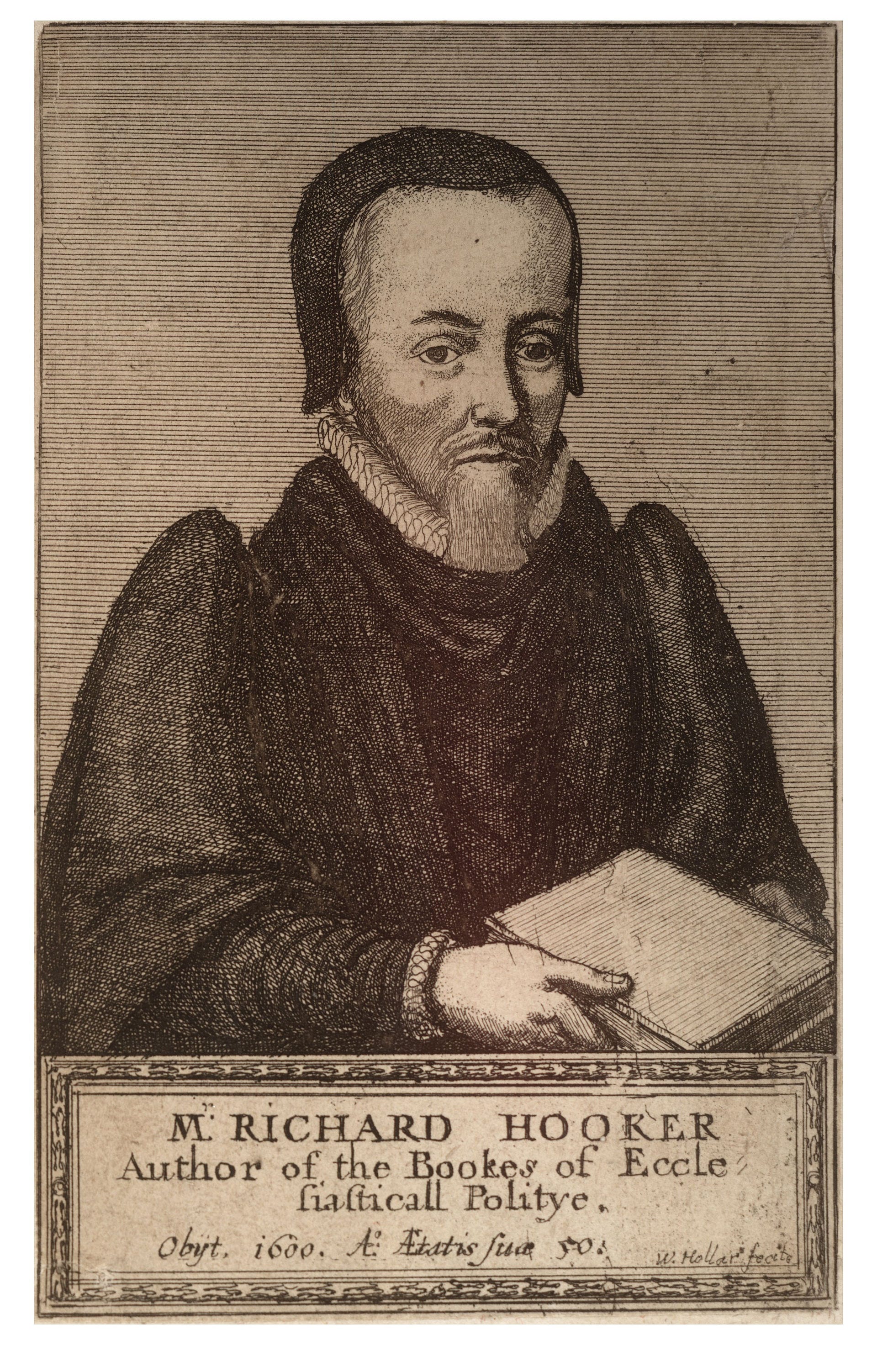

Appealing to Richard Hooker is perhaps a cop-out. Of course, I would appeal to Richard Hooker! But actually, I think there is something here. Even acknowledging that Hooker wasn’t immediately the towering figure within Anglican theology that he is today, I think the framework he created in his Laws of Ecclesiastical Polity was robust enough to become a controlling framework for the lowercase-’r’ reformed Anglican formularies. To me, this becomes clear when we place it side-by-side with the Roman Catholic system of pure nature and the Reformed system of covenants. Whereas the Roman Catholic system is primarily a metaphysical approach to understanding the creation of humanity and their relationship to God, and the Reformed covenantal approach is primarily a forensic/legal approach (I say this with all of the caveats actual experts on these topics would throw at me), Hooker’s conceptual framework of law does both.
One must remember that ‘law’ for Hooker was not a merely extrinsic legal demand, but the internal ordering of the created universe that gave it both 1) structure and 2) purpose. This is because the law was ultimately a reflection of God’s character. It comes from God, is structured by God, and is ordered back to God. Hooker firmly believes that humans as such were created for a relationship with God, and so denies the Roman Catholic doctrine of pure nature, and yet he has plenty of room within his framework to permit discussions of natural law and philosophical reflection on human nature qua nature, ordered individually and in community.
I know, of course, that each of the Roman Catholic and Reformed systems makes up for its supposed deficiencies in different ways, most of which I am too unfamiliar with to adequately speak about. Again, my concern is not so much with the details but with the proposal that it is Hooker’s use of the concept of Law that grew, via the Caroline Divines, into the dominant controlling metaphor that gave Anglicanism its distinctive shape. The power of Hooker’s model may also explain why the Anglican tradition emphasized things such as moral order (e.g., the beauty of holiness, which those in more of the uppercase-’R’ Reformed tradition took as moralism) and sacramental participation.
What I find so satisfying about this approach is that it can both appreciate and indeed approve of the historic Anglican formularies without plugging our noses while also not feeling trapped in the 16th century. The model of Hooker is then to be seen as the way in which this lowercase-’r’ reformed tradition took shape in a distinctive way according to a philosophically and theologically robust conceptual framework. If this is the case, I think it would challenge both the catholic leaning Anglicans that they need not distance themselves from the first-generation Anglican reformers, and the evangelical/Reformed Anglicans that they need not reduce Anglicanism to an off-brand Presbyterianism.
I’d love to know what you think! Hopefully, I gave a specific enough argument to engage with, but broad enough to actually be interesting.
Great stuff! I learned something and look forward to more.
Also, co-opting this part.
"For good reasons or bad, I just can’t sign up for #team[fill in the blank].
This presents a problem for someone who has signed up to [be part of the Protestant church]! I’d rather not say, ¯\_ (ツ)_/¯, and I can’t just “pick” a camp and go with it."
Interesting distinction. Like this, and share many of your impulses!